


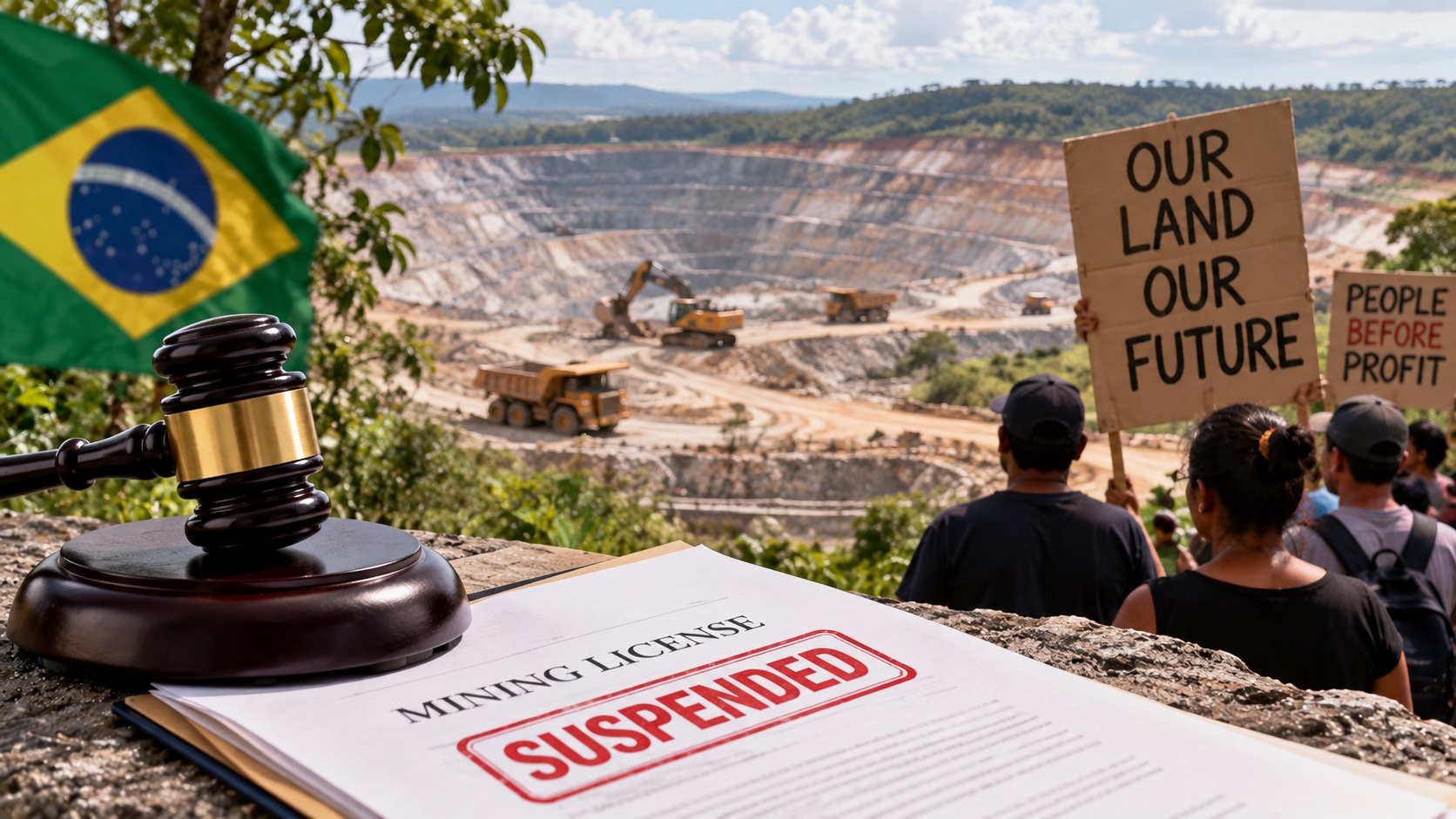
A Brazilian court has ordered the suspension of environmental licenses and mining activities at Sigma Lithium’s Grota do Cirilo mine in Minas Gerais, raising fresh questions about the environmental and social challenges surrounding the global race for lithium.
The court issued the ruling on September 4, and Reuters reported it on September 6. It followed a civil lawsuit filed by the Federation of Quilombola Communities of Minas Gerais, which argued that the mining project falls within the Bau Quilombola community’s area of influence. Quilombolas are traditional communities of African descent whose territories are legally protected in Brazil.
Court Raises Concerns Over Community Consultation
Judge Antonio Lucio Tulio de Oliveira Barbosa found sufficient evidence that the Bau community’s territory could fall within the project’s area of influence.
According to the court, studies indicated the territory is about 2.7 kilometres from the mining project’s directly affected area. The judge said this could trigger requirements for more extensive environmental procedures, including free, prior and informed consultation with the affected community.
The court also pointed to the mining operation’s ongoing blasting and earthmoving activities as a potential risk to the community.
An independent expert is expected to determine the precise distance between the mining project and the Quilombola territory.
Sigma Lithium Disputes the Decision
Sigma Lithium has challenged the circumstances surrounding the ruling.
The company said it had not received official notification of the decision and described it as a preliminary ruling issued without due process. Sigma said it intended to begin its legal defence.
The court’s order, meanwhile, suspends the environmental licences and prevents the state of Minas Gerais from issuing new licences for the operation. The ruling also establishes a financial penalty if the company continues operations in violation of the order.
Why This Matters to the Global Battery Industry
The Grota do Cirilo mine is particularly important because it is Sigma Lithium’s only producing asset, with a nameplate capacity of approximately 330,000 tonnes of lithium oxide concentrate annually.
The case highlights a growing tension within the global energy transition.
Lithium is essential for many modern batteries, including those used in electric vehicles and energy-storage systems. Demand for the mineral is therefore expected to remain closely linked to the expansion of battery technologies.
But producing more lithium also brings questions about land use, environmental protection, water, local communities and the permitting process.
Brazil’s case demonstrates that the challenge facing the battery industry is no longer simply securing enough lithium.
It is also about how that lithium is produced.
As countries accelerate their transition toward electric vehicles and renewable-energy storage, an important question remains:
How much environmental and social responsibility should be required from the companies supplying the minerals behind the global battery transition?
And ultimately:
Can the world build a cleaner energy future without creating new environmental and social costs along the way?
Read the Latest Battery News Shaping the Global Power Market
References
