


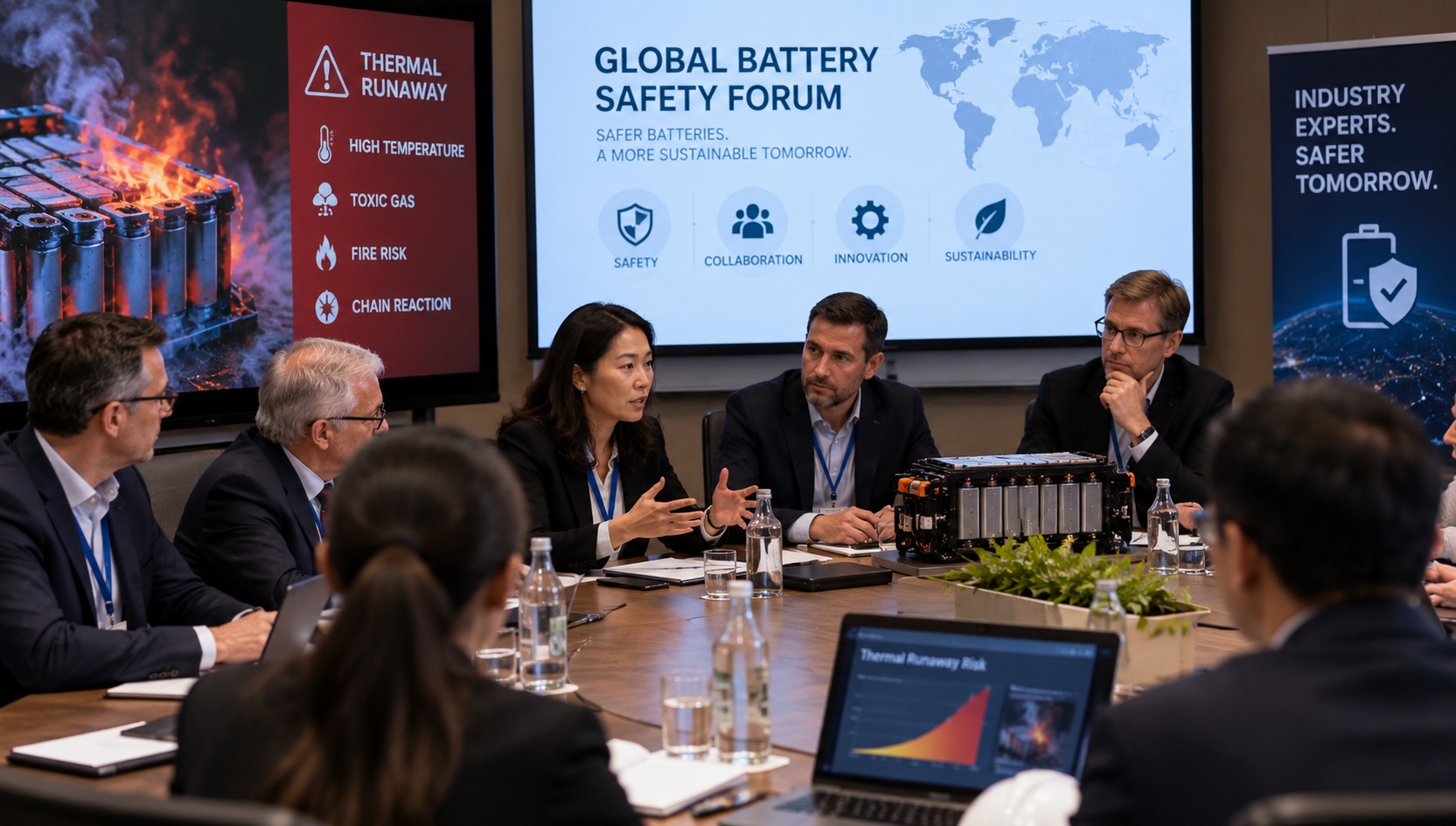
As lithium-ion batteries become increasingly powerful and widely deployed, battery-safety experts, researchers and industry leaders are meeting in Chicago this week to address one of the technology’s most difficult challenges: preventing and detecting battery fires before they escalate.
The 16th Annual Battery Safety Summit, taking place on August 12–13, 2026, is bringing together specialists from across the battery and energy-storage industry to discuss safety testing, battery-management systems, charging technology, thermal stability, diagnostics and fire prevention.
One of the central issues at the summit is thermal runaway, a chain reaction in which a battery cell begins generating excessive heat, potentially causing neighbouring cells to fail.
According to the summit programme, thermal propagation is considered one of the most critical safety challenges in modern energy-storage systems, particularly as battery energy densities continue to increase across electric vehicles, stationary storage and consumer applications.
Detecting a Battery Fire Before It Spreads
Researchers are also examining whether current battery-monitoring systems can detect thermal runaway early enough.
One presentation at the summit is examining the limitations of temperature sensors in commercial battery packs. The programme notes that EV battery packs can rely on relatively sparse temperature sensing, making early detection of an individual failing cell difficult. Researchers are therefore investigating alternative methods, including gas sensors and electrochemical impedance measurements, to identify early signs of battery failure.
Another presentation focuses on lithium-ion battery fire suppression in aircraft cargo compartments. Researchers warn that increasingly large portable lithium-ion batteries can present significant fire hazards, while existing immersion approaches may not always provide sufficient protection during prolonged flooding.
The summit is also examining safety across different battery chemistries and cell designs, including strategies to prevent thermal runaway from spreading from one cell to another.
A Growing Global Safety Challenge
The timing of the summit reflects a broader challenge facing the battery industry.
Higher energy density allows batteries to store more energy in smaller and lighter packages, but it also makes thermal management, monitoring and failure prevention increasingly important.
The industry is therefore investing not only in higher-performing batteries, but also in technologies designed to make failures easier to detect and contain.
For battery users worldwide, this raises several important questions:
Are today’s battery-management systems capable of detecting failure early enough?
Are manufacturers doing enough to prevent thermal runaway from spreading?
And as batteries become more powerful, are safety standards and emergency-response systems advancing at the same speed?
The answers could become increasingly important as lithium-ion batteries move into more homes, vehicles, businesses and energy-storage systems around the world.
Read the Latest Battery News Shaping the Global Power Market
