


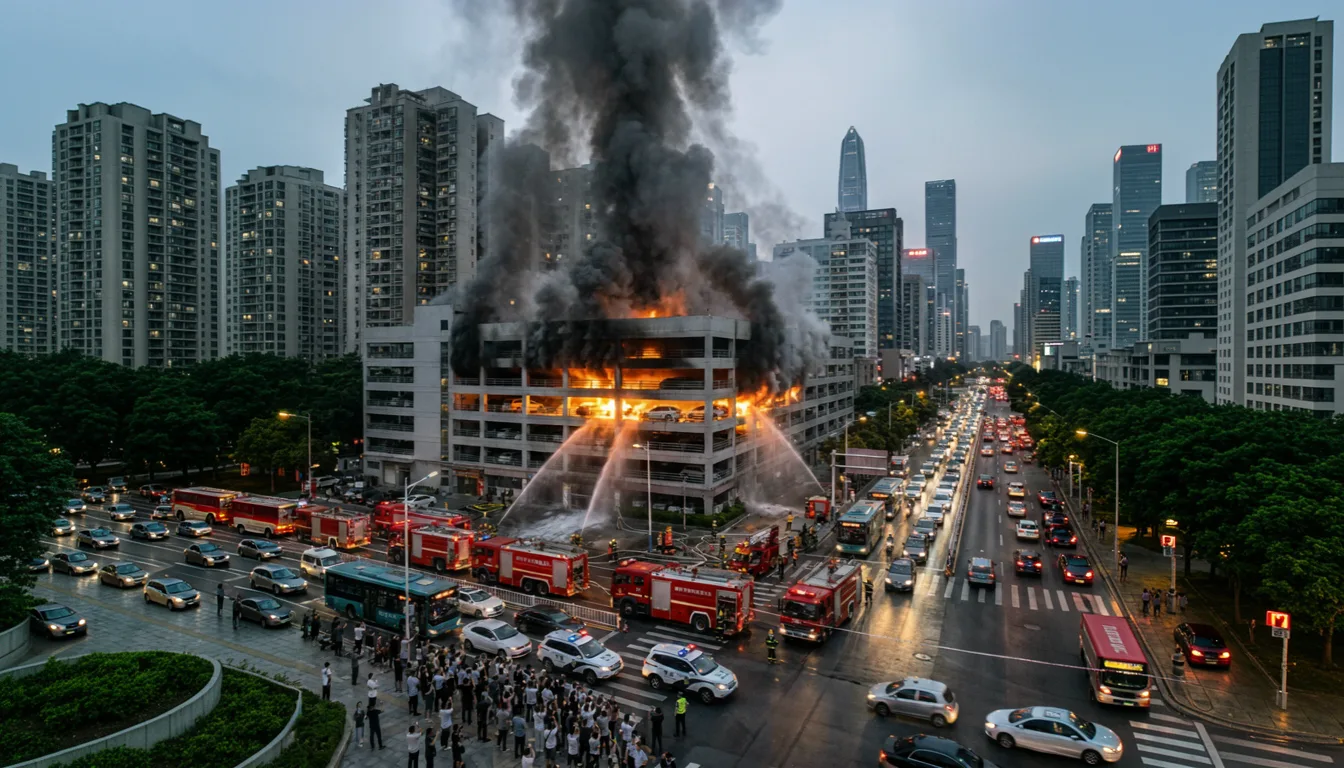
A fire at a parking garage owned by Chinese electric vehicle giant BYD Company in Shenzhen has once again placed lithium-ion battery safety under global scrutiny, even as preliminary reports suggest no casualties and rapid containment of the incident. The blaze broke out on April 14, 2026, at a multi-story facility inside an industrial park used to store test and scrapped vehicles. Emergency crews extinguished the fire after thick smoke and flames were seen rising from the structure.
While the company confirmed that no injuries occurred, the scale of the incident has heightened concerns about EV infrastructure safety, particularly in dense urban environments where large volumes of electrified vehicles are stored, charged, or decommissioned. Early reporting indicates the fire originated in a designated parking area for non-customer vehicles, including test units and scrapped stock, rather than active consumer fleet vehicles.
Although official statements have not linked the incident directly to a battery defect, experts note that EV-related fires behave differently from conventional vehicle fires due to the presence of high-energy lithium-ion battery packs. Once damaged or thermally destabilized, these systems can enter a state of thermal runaway, an uncontrolled reaction that generates intense heat, flammable gases, and prolonged burning. In some cases, re-ignition occurs even after initial suppression efforts.
The incident also highlights the operational risks associated with large-scale EV manufacturing and storage ecosystems. Facilities that handle prototype vehicles, end-of-life units, and battery-equipped scrapped cars often concentrate multiple high-energy systems in confined spaces, increasing the risk of fire propagation under fault conditions.
Brands such as BYD, along with global EV manufacturers including Tesla, Hyundai, Volkswagen, and NIO, continue to scale production of electric vehicles equipped with lithium-ion battery systems. While modern chemistries like BYD’s Blade battery (a lithium iron phosphate-based design) are engineered for improved thermal stability, no lithium-ion system is entirely immune to failure due to mechanical damage, electrical faults, or external ignition sources.
Fire safety analysts emphasize that as EV adoption accelerates, the risk profile is shifting from individual vehicle incidents to infrastructure-level hazards involving parking structures, logistics hubs, and storage depots.
Authorities are expected to conduct a detailed investigation to determine whether external factors, mechanical faults, or operational conditions contributed to the Shenzhen blaze. The findings may have implications for future safety standards across EV manufacturing and storage environments.
A Warning Ignored
As electric vehicle deployment expands, lithium-ion battery systems are increasingly embedded across industrial and urban spaces. Without a stringent fire-safe design in parking infrastructure, disciplined handling of damaged units, and robust thermal risk controls, a single localized failure can escalate into large-scale structural fires with rapid spread, severe property loss, and heightened risk to emergency response personnel.
Read the Latest Battery News Shaping the Global Power Market
Reference
